
What Are the Objectives of a Market Survey, and How Do I Set Them?
My survey gets answers, but my decision still feels blurry.
The objectives of a market survey are the specific things I need to learn so I can make a real decision—about demand, customers, pricing, messaging, or competition.
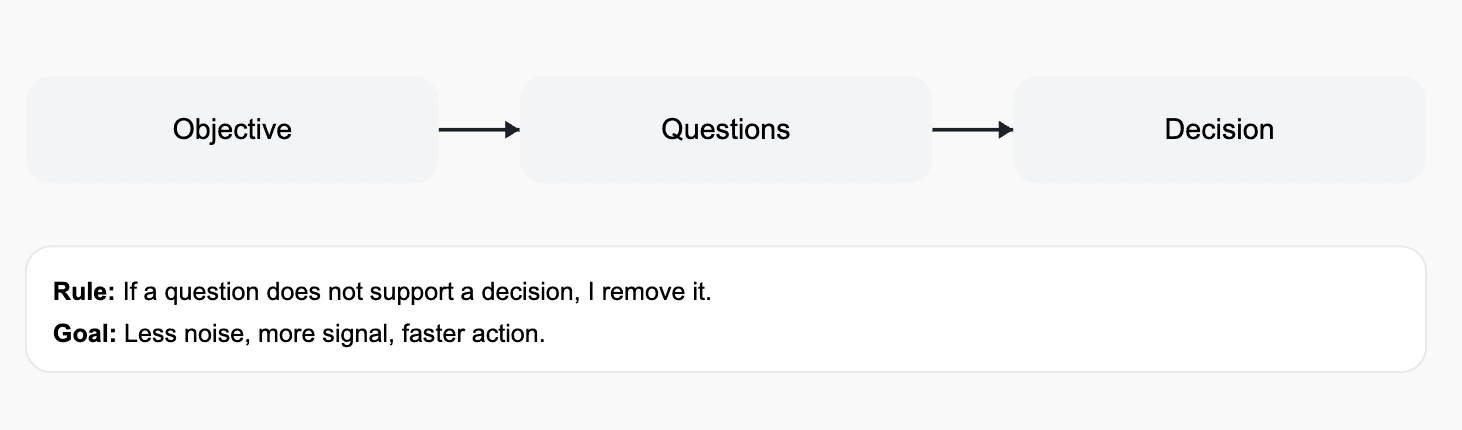
I treat objectives like a “noise filter.” If I set them well, the survey becomes short, clear, and useful. This is the same mindset I use on Astrodon: remove noise → reveal the real signal.
Before I write any question, I write my objectives as decision statements. I keep them concrete. I avoid “understand the market.” I write “choose a target segment” or “set a price range.”
What Are the Objectives I Should Set Before Writing Survey Questions?
I should set objectives that tie directly to a decision I will make within a clear time window. I always start with “What will I do differently after I see the results?” If I cannot answer that, I do not have a real objective yet.
I usually set 3–5 objectives, not 12. Too many objectives create a long survey and weak answers. I also write each objective in a simple format: Objective → Decision → Success metric. For example: Objective: identify top pain points → Decision: choose the headline promise → Success: higher signup rate. This keeps me honest. It stops me from asking “interesting” questions that do not change anything.
I also set boundaries. I decide who the survey is for. I decide what segment I care about. I decide what I will not measure in this survey. This discipline matters because surveys can expand forever. If I keep scope tight, I can act faster.
What Are the Core Objectives of a Market Survey?
The core objectives are to measure demand, understand customers, test messaging, estimate willingness to pay, and map the competitive and substitute landscape. I do not need all of them every time. I pick the ones that match my decision.
Here is the objective-to-decision mapping I use most:
| Objective | What I’m trying to learn | What I decide next |
|---|---|---|
| Demand intensity | how urgent the problem is | whether to pursue the idea |
| Segmentation | which group feels it most | who to target first |
| Current alternatives | what they use today | what I must beat |
| Value drivers | what matters most | positioning angle |
| Messaging fit | which promise lands | headline + offer |
| Willingness to pay | acceptable ranges | pricing & packages |
| Channel habits | where they discover tools | marketing channels |
I also add one objective that many people skip: switching friction. I ask what stops them from changing. This gives me a more realistic plan. If switching is the barrier, I need migration help, proof, or a safer trial. If urgency is the barrier, I need a sharper use case.
How Do I Translate Objectives Into a Survey That Works?
I translate objectives into a survey by writing one measurable question per objective, then adding only the minimum context questions needed to segment results. I keep the survey short because short surveys get better completion and better quality.
I do this in a strict order. First, I add screeners. I confirm the respondent is in the target group. Then I add behavior questions. I ask what they did recently, not what they think they might do. After that, I add evaluation questions. I ask what matters, what they dislike, and what they would change. Finally, I add commitment questions. I ask if they would take a next step. This sequence keeps the survey grounded.
I also avoid a common trap: writing objectives that require a different method. For example, if my objective is “prove cause and effect,” a survey alone is weak. I need an experiment. So I keep survey objectives realistic: measure patterns, rank priorities, and identify segments. If I need proof, I plan a follow-up test.
How Do I Know If My Market Survey Met Its Objectives?
I know it met its objectives when it produces clear, segment-specific findings that point to a single next decision, with minimal ambiguity. I do not judge success by response count alone. I judge it by decision clarity.
After I close the survey, I write results in the same structure as objectives. For each objective, I write Finding → So what → Action. I keep it short. If I cannot write an action, the objective was not set correctly, or my questions were too vague. I also check if results differ by segment. If all segments look the same, I either targeted too broadly or the market is truly uniform. If one segment shows stronger urgency and willingness to pay, that becomes my focus.
I also look for contradictions. If respondents say the pain is huge but nobody will take a next step, I treat that as a warning. It usually means I asked about opinions, not behavior. In that case, my next action is a small validation test, not a bigger survey.
Conclusion
Market survey objectives exist to drive decisions. If my objectives are clear, my survey becomes shorter, cleaner, and more useful.